8 min readElif Aksoy
Egg Timer: How Long Do You Boil an Egg?
Perfect jammy yolk or sad grey ring? It's 90 seconds apart. A free online timer nails every egg — here are the exact minutes.
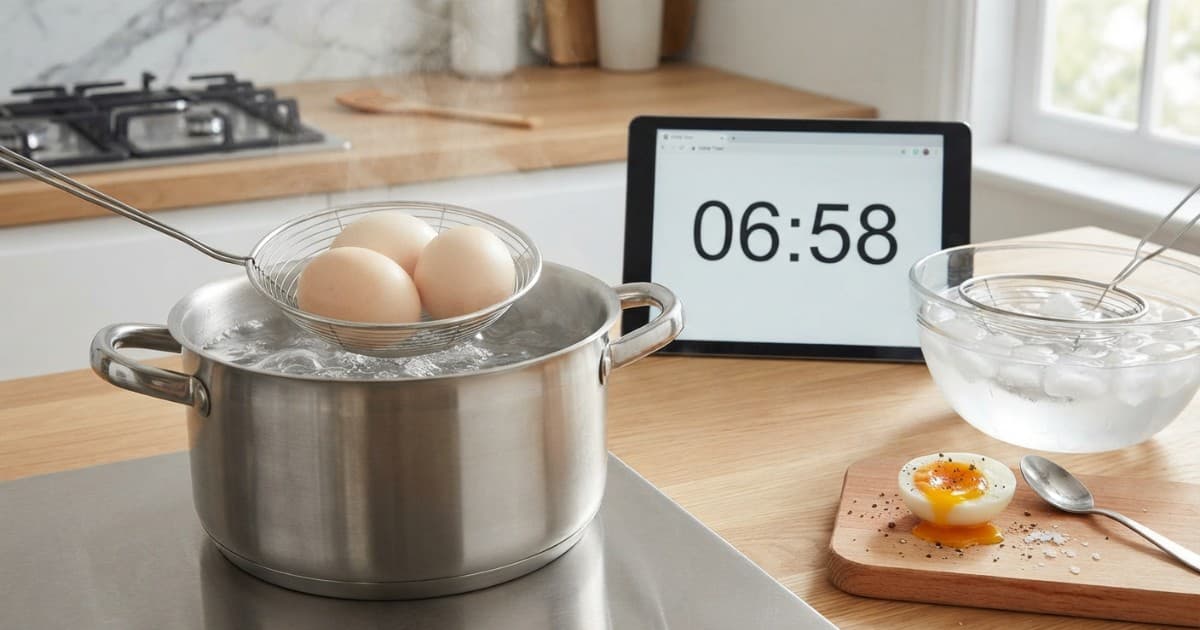
Six to seven minutes for a soft, jammy yolk; twelve for fully hard-boiled — those two numbers cover most of what you'll ever need, and the whole trick is simply not guessing them. The gap between a perfect spoonable yolk and a dry, grey-rimmed one is about 90 seconds, and nobody can eyeball 90 seconds while doing three other things in the kitchen. The fix isn't a fancy gadget. It's a free online egg timer in your browser: set the minutes for the egg you want, start it the moment the water boils, and walk away. Here are the exact times, the one step most people skip, and how to run a reliable egg timer online.
Why eggs are so easy to get wrong
Eggs are deceptively technical because the white and the yolk set at different temperatures. The white starts firming up at a lower temperature than the yolk, so there's only a narrow window where the white is fully set but the yolk is still soft and jammy — and that window is measured in seconds, not minutes. Overshoot it and the yolk turns chalky and grey; undershoot and the white stays loose and slippery. That's the whole reason a timer beats instinct here: you can't judge the inside of an egg by looking at the outside, so instead you hit a precise result by controlling the one thing you can measure — time in boiling water. Nail the minutes and the chemistry takes care of itself.
The exact boiling times (from boiling water)
Bring a pot to a rolling boil, gently lower the eggs in, and start your online timer the instant they hit the water:
6 minutes — soft-boiled: runny yolk, just-set white. For dipping soldiers.
7 minutes — jammy, spoonable yolk. The sweet spot for ramen, toast, and rice bowls.
8 minutes — fudgy, barely-set center. Still creamy, easier to handle.
10 minutes — firm but tender all the way through.
12 minutes — fully hard-boiled, sliceable, no grey ring.
The instant the timer rings, move the eggs into ice water. That single step stops the cooking dead, and it's the difference between a clean yellow yolk and the overcooked grey-green ring that forms when eggs keep cooking in their own residual heat.
Soft, jammy, or hard — which are you actually after?
Most "overcooked egg" disappointments come from aiming at the wrong number. If you want a yolk that runs, you're in 6-minute territory and you have to eat it hot. If you want that famous jammy center that holds its shape but stays glossy, 7 minutes is your number — it's forgiving and works for almost everything. Need to slice it onto a salad or pack it for lunch? That's a 10-to-12-minute hard-boil. Knowing which result you want before the water boils is half the battle; the timer handles the other half.
The step everyone skips: the ice bath
An ice bath isn't optional garnish — it's part of the technique. Eggs hold a lot of heat, and a hard-boiled egg left to cool on the counter keeps cooking for another minute or two, which is exactly how you get that grey ring and a faint sulfur smell. Dropping them straight into a bowl of ice water halts the process instantly, and the rapid contraction also makes them dramatically easier to peel. Have the ice bath ready before the timer rings, not after.
Why an online egg timer beats guessing (and your phone)
Your memory is not a timer. "I'll just keep an eye on it" is precisely how eggs get forgotten while you answer a text or chop something else. A browser online timer sits open on your screen, counts down where you can see it, and alarms loudly when it's done — no app to install, no phone to unlock with wet or eggy hands. You open it once, set the minutes, and cook with both hands free and your attention on the food.
How to set an egg timer online
Open the online timer and enter the minutes for the egg you want (see the list above).
Start it the second the eggs go into the water — not when it merely "looks like it's boiling."
Turn the volume up so you'll hear the alarm from anywhere in the kitchen.
Have the ice bath ready. When it rings, the eggs go straight in.
Cold-start vs boiling-water start
There are two schools of egg-boiling, and they need different timers. The times above assume a boiling-water start — eggs added to already-boiling water — which gives the most consistent, repeatable results and easier peeling. The alternative is a cold start, where eggs go into cold water that you then bring to a boil; timing there is fuzzier because it depends on how fast your stove heats the pot, which is exactly the kind of guesswork a fixed timer is meant to remove. If you want numbers you can trust and repeat, boil the water first, then start the timer.
Fridge-cold vs room-temperature eggs
Egg temperature changes the result too. Straight-from-the-fridge eggs run a touch cooler and can cook slightly slower, and dropping very cold eggs into rapidly boiling water raises the risk of cracking. For the most reliable timing, let eggs sit out for a few minutes first, or lower them in gently with a spoon. If you're cooking cold eggs, nudge the timer up by about 30 seconds — and once you find the exact number that works for your stove and your fridge, write it down and reuse it every time.
The peeling problem, solved
Half the frustration with boiled eggs isn't the cooking — it's the peeling, when the shell fuses to the white and tears chunks out of it. Two things make peeling easy. First, the ice bath: rapid cooling contracts the egg away from the shell, so have it ready and use it every time. Second, egg age — very fresh eggs are notoriously hard to peel, while eggs that are a week or two old peel far more cleanly, so save your oldest eggs for boiling. When you're ready, tap the egg all over, roll it gently to craze the shell into small pieces, and start peeling from the wide end, where there's usually an air pocket to get under.
Boiling a big batch for the week
Meal-preppers can boil a dozen eggs at once, and the same rules apply — just more carefully. Don't crowd the pot: too many eggs drop the water temperature when they go in and cook unevenly, so use a wide pan with enough water to cover them by an inch, and split into two batches if you're unsure. Keep the same online timer running for the whole batch, shock them all in ice water together, and — peeled or left in the shell — they'll keep in the fridge for about a week. One timer and one big pot turns "perfect eggs" from a fussy skill into a Sunday routine.
A quick word on egg size and altitude
Two things can shift the numbers slightly. Larger eggs need a touch more time and smaller ones a touch less — the times here assume standard large eggs, so nudge by 30 seconds or so for jumbo or medium. And if you live somewhere high, water boils at a lower temperature, so eggs cook a little slower; at serious altitude you may need an extra minute or two. Neither changes the method — you still start the timer the moment the eggs hit boiling water — you're just adjusting the number to your kitchen. Find what works once, write it down, and repeat it forever.
Beyond eggs: everything a timer quietly saves
Eggs are the classic case, but the same online timer rescues anything where a minute or two decides the outcome: steeping tea before it turns bitter, resting a steak so the juices settle, proofing dough, boiling pasta to the exact bite you like. Cooking is full of these "don't walk away too long" moments, and a visible browser timer with a loud alarm beats your memory every single time.
Common egg-timing mistakes
Starting the timer too early or too late. Start it the moment the eggs enter boiling water — not when you turn on the stove, and not a minute in.
Skipping the ice bath. Residual heat overcooks the yolk and welds the shell to the white. Shock them cold.
Crowding the pot. Too many eggs drop the water temperature; boil in batches or give them room.
Guessing instead of timing. That's the whole point. Ninety seconds is the margin — protect it with a timer, not a hunch.
Related guides
Perfecting breakfast is one piece of a solid morning — see how to become a morning person, or fall asleep faster the night before with the military method.
Other time tools
All free, all browser-based. One tap away.
Alarm
One-time or recurring alarm with gentle wake.
Timer
Count down from any duration. Keyboard-friendly.
Stopwatch
Centi-second precision with lap splits.
Countdown
Count down to any future date or event.
Clock
Fullscreen analog or digital clock.
World Clock
Live local time in any city, side by side.
Date Calculator
Find the days between two dates, or add/subtract time.
Age Calculator
Exact age in years, months and days from a birthdate.
Pomodoro
Focus blocks with auto-cycle and tasks.